Friday Focus #77: What to Say When a Patient Asks to Pay Per Visit (The Power of the Pause)
Nov 06, 2026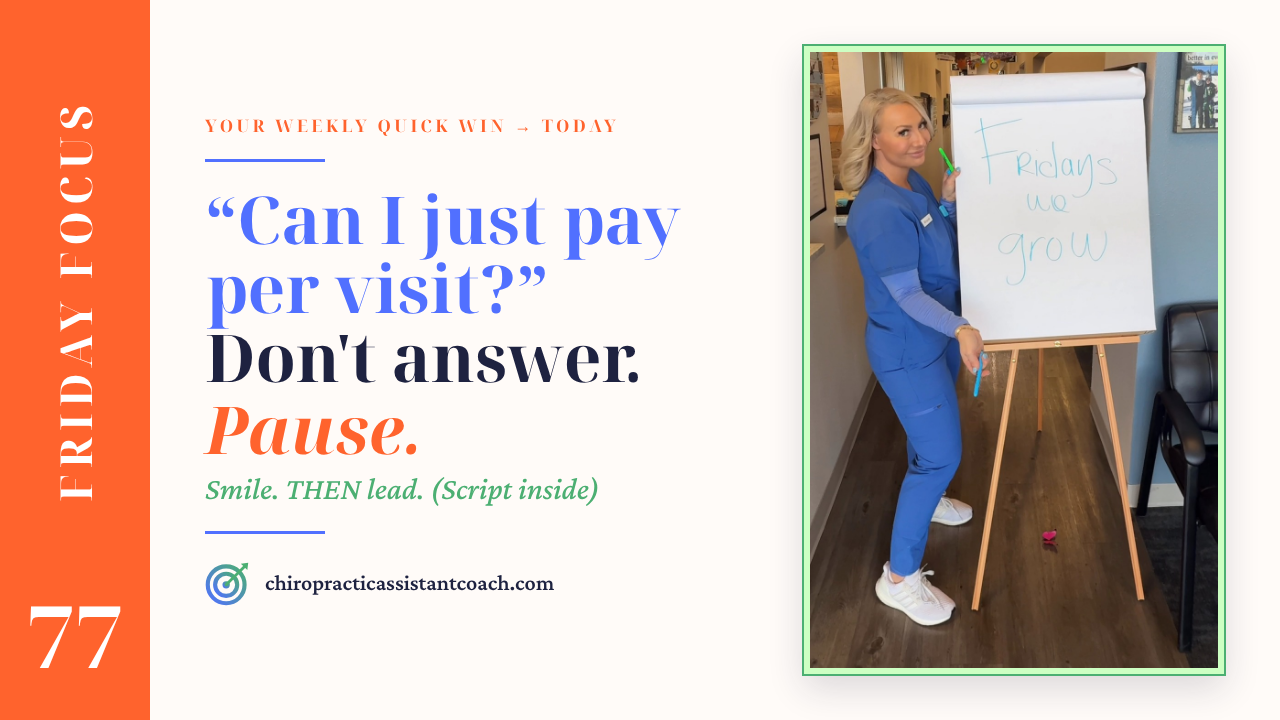
Friday Focus #77 · One quick win your chiropractic team can do today
What should a chiropractic office say when a patient asks to pay per visit? Don't rush the answer and don't send them to the doctor. Pause. Smile. Then lead them to the option that keeps them most consistent with their care.
The fastest answer is rarely the best one.
"Can I just pay per visit?" is one of those questions that makes a front desk tense up. Today's focus takes about 10 minutes with one teammate: role play that ONE question, practice the pause before you answer, and then lead. I'm giving you the exact words I teach for this moment, word for word, right here in this post.
Quick heads up before we dive in, because every office handles this a little differently.
If your office doesn't offer pay per visit (or would rather your patients commit to a plan)... this one is for you. The script below is the exact one I teach for that moment.
If your office DOES offer pay per visit... stay with me. Your patients still ask this question, and the pause + the lead work exactly the same way. You'll just lead toward whatever option keeps your patient most consistent. There's something in here for you too.
If you're a D.C. reading this, there's a part below just for you. And if you're a C.A. (Chiropractic Assistant) reading this, you're the one who gets to practice this before your next patient asks. 🎯
Why "Can I just pay per visit?" gets rushed (or handed off)
Picture it. Your patient just finished their care plan. They feel GREAT. They're at the front desk, card in hand, and they say it.
"Can I just pay per visit?"
And in that half second, one of two things usually happens. The C.A. talks fast to fill the silence... or the C.A. says "let me grab the doctor for that one."
I get it. Money questions can feel uncomfortable, right? Nobody wants to feel pushy. So we rush to make the awkward part end.
Truth over comfort... the rush is what makes it awkward. And handing it straight to the doctor tells the patient this is a big scary question, when it's actually a very normal one. (Same energy as the patient who says "I need to talk to my spouse"... the question on the surface is rarely the whole question. I broke that one down in Why Patients Say "I Need to Talk to My Spouse".)
So pause here for a second. The last time a patient asked about payment at your front desk, what came out of your mouth first? A pause... or a paragraph?
Today's focus: role play ONE question (do this TODAY)
On Wednesday I taught a live training inside the Connected Community on exactly this moment, and I had EVERYBODY role play it. Someone asked me the pay per visit question live... and they did NOT make it easy. 🤗 That's the best kind of practice.
Now it's your team's turn.
- Grab a teammate. One of you is the patient. The other is the C.A.
- Patient asks: "Can I just pay per visit?"
- C.A.... do NOT answer right away. Pause. Smile. Look up like you're thinking.
- THEN lead. Use the script below, with your plan, your real numbers, and the payment options your doctor approves.
- Switch seats and do it again. Twice each is plenty for today.
Ten minutes. One question. Two seats. Does that make sense?
The word for word pay per visit script
This is the slide we used in the live training. Save it, print it, tape it next to your monitor.
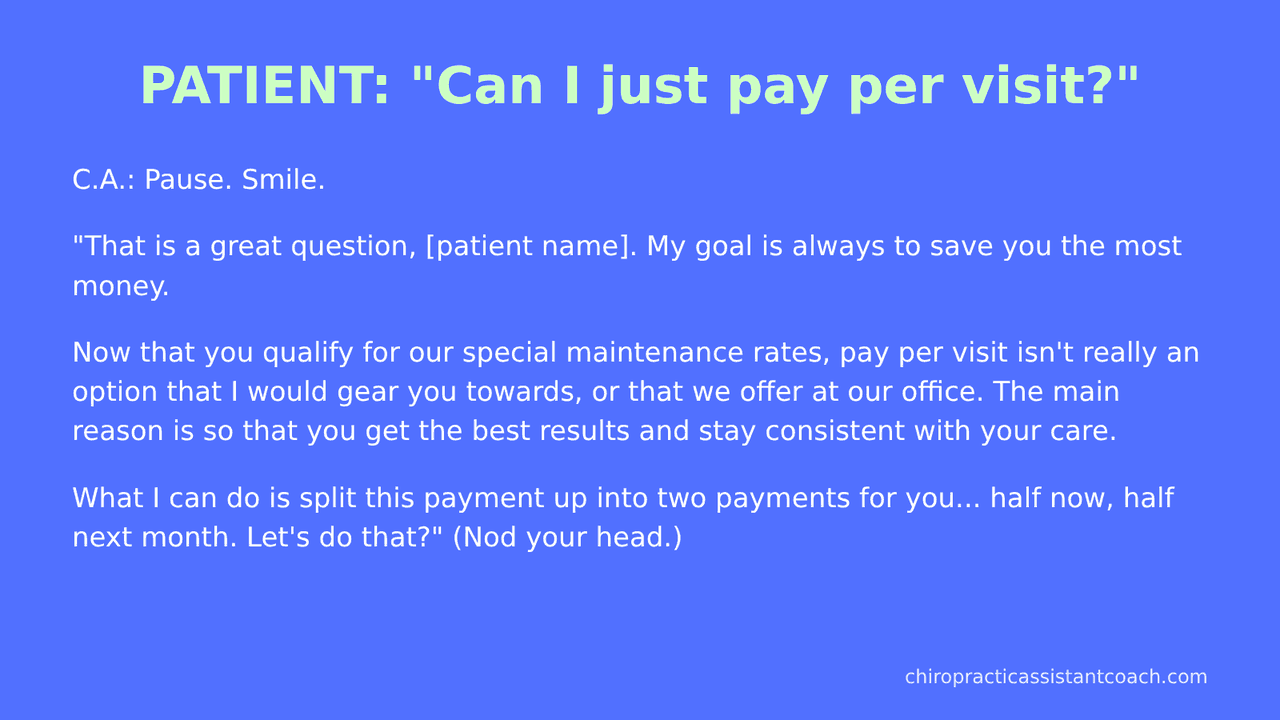
PATIENT: "Can I just pay per visit?"
C.A.: Pause. Smile.
"That is a great question, [patient name]. My goal is always to save you the most money.
Now that you qualify for our special maintenance rates, pay per visit isn't really an option that I would gear you towards, or that we offer at our office. The main reason is so that you get the best results and stay consistent with your care.
What I can do is split this payment up into two payments for you... half now, half next month. Let's do that?" (Nod your head.)
Do you see what I'm doing there? I never asked IF they wanted to keep going. I answered the real question underneath ("can this feel easier on my wallet?") and then I led with an option.
And one quick note, with love. This script was built for a patient who just graduated into maintenance care, in an office that doesn't offer pay per visit. If your office DOES offer it, don't say you don't. Keep the pause + the lead, and make the rest YOURS... your plan, your real numbers, and the payment options your doctor approves. Monthly packages, yearly plans, a two payment split, pay per visit, whatever is true in your office. If your patients ask something else, role play that instead.
Why the pause does the heavy lifting
That pause isn't you stalling. It's you showing the patient you actually heard them.
Think about it from their side. A rushed answer sounds rehearsed. A paused answer sounds like you're thinking about THEM. Same words. Totally different feeling.
And the pause shows up again at the end. After "Let's do that?"... you stop talking. You smile. You let them answer. The power of the pause works on both sides of the question.
And the research world noticed this a long time ago. Back in 1986, education researcher Mary Budd Rowe published a review in the Journal of Teacher Education on what she called "wait time." Teachers usually waited less than a second after asking a question. When that pause stretched to three seconds or more, she found pronounced changes in how students used language and logic. Different room, same truth. People give better answers when you give them a little quiet.
So who on your team is the fastest talker when money comes up? (You already know who. Maybe it's you.)
Braces, retainers, and pay per visit (a quick tangent)
Okay, quick tangent. Have you ever had braces or Invisalign? Or know someone who has?
Now picture someone finishing their braces and saying, "I'll just wear my retainer when I feel like it."
What happens? The teeth slowly drift right back to where they started. All that time. All that money. Gone, a little at a time.
Side note... actually no, it's not a side note, it's the whole point. Corrective care is the braces. Maintenance care is the retainer. And "I'll just pay per visit" very often turns into "I'll just come in when it hurts."
That's why this script leads back to the plan instead of to a price. You're not selling anything. You're helping your patient protect what they already invested in. That's what the pause makes room for.
Which of your patients finishes their plan in the next 30 days? Those are the ones to practice for today.
For my D.C.s reading this
With love, Doc... this one might look like a C.A. problem. It's an office problem with a C.A. solution.
If you're the D.C. whose team sends every money question to you, this is one of the simplest places to start. Every handoff pulls you out of the adjusting room AND tells the patient the C.A. isn't the person to trust with their plan. Ten minutes of role play changes that.
And if you're the D.C. with a rock star team that already handles payment conversations... ask yourself one question. Are they leading the patient, or just answering the patient? Those are two very different conversations. And don't box in what's possible for your patients. I once had a patient trust our office enough to prepay for SEVEN years.
So here's the task you hand your C.A. today:
"Before you clock out, role play the pay per visit question with a teammate. Twice each. Then tell me which part felt hardest... the pause or the lead."
Then at your next huddle, ask out loud: "Who got asked about payment this week, and did you pause first?"
One gentle frame, with love... handing this to your team is delegating. Handing it over and never asking about it again is abdicating. Trust your team with the conversation. Keep the question for yourself.
For my C.A.s reading this 🤗
This is your permission slip to LEAD, not just work.
You don't need to grab the doctor every time a patient says the word "pay." You're allowed to hold that conversation. You're the one who knows their schedule, their card on file, and the little details from their last visit.
Will it feel a little pushy + a little awkward at first? Probably. GOOD. You're getting uncomfortable to get comfortable.
And if the patient still says no today? A no is a not yet. You still have visits on the schedule to keep the conversation going.
Awkward today... SO much easier the next time you hear it.
So who's your role play partner today?
Rushed teams vs. connected teams
❌ Rushed teams hurry through the answer or hand it straight to the doctor.
✅ Connected chiropractic teams practice the pause... and lead the conversation that keeps patients consistent with their care.
So which one is your office right now? Are you the team that fills the silence... or the team that lets the pause work?
Frequently asked questions
What do you say when a chiropractic patient asks to pay per visit?
Pause and smile first. Then thank them for the question, tell them your goal is to save them the most money, explain that the plan keeps them consistent so they get the best results, and lead with a payment option your doctor approves, like splitting the plan into two payments. Finish with "Let's do that?" and let them answer.
Should a chiropractic office offer pay per visit?
That's a decision for each D.C. Some offices offer it, and some only offer plans or packages. Whatever your office decides, your team should say it truthfully and lead the patient toward the option that keeps them most consistent with their care.
Why should the C.A. pause before answering a payment question?
A pause shows the patient you heard them and are thinking about them, not reciting a script. It also keeps you from talking fast to fill the silence. After you offer the option, pause again and let the patient answer.
Should the Chiropractic Assistant send payment questions to the doctor?
Usually not. Handing every money question to the doctor pulls the D.C. out of patient care and can make a normal question feel like a big one. When the C.A. is trained and knows the options the doctor approves, the C.A. can lead the conversation with confidence.
How do you role play payment conversations with your chiropractic team?
Pair up. One person plays the patient and asks the real question, like "Can I just pay per visit?" The other plays the C.A., pauses, smiles, and leads. Switch seats and repeat. Ten minutes a week builds the confidence that a script on paper can't.
Your one move before you close the tab
You don't need a better answer. You need a better first second.
Grab one teammate, ask the one question... and let the pause do its job before you say a word. That's today's assignment.
The pause isn't empty. It's where the patient decides you're worth listening to.
🎯 Ready for a team that leads every payment conversation?
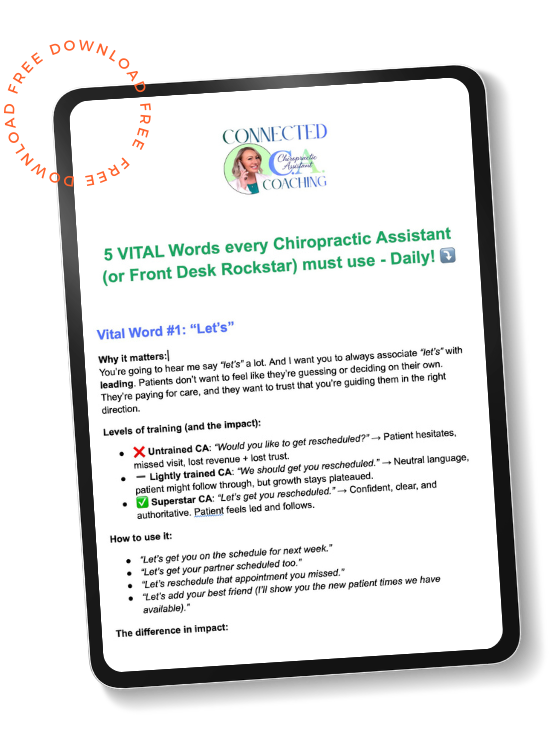
1. Grab my free 5 Vital Words. "Let's do that?" is one of them in action. These five words help your C.A. lead instead of asking permission. DM me the word WORDS on Instagram and I'll send them to you → @chiropracticassistant
2. Bring your C.A. into the Connected Community. The full replay of this live role play training lives in the Video Vault, along with two live calls a month, a replay vault of C.A. trainings, Morning Momentum every weekday, and a community of C.A.s who love this profession as much as you do → chiropracticassistantcoach.com/chiropractic-assistant-coaching-membership
3. Certify your team in the C3 method. Connect → Commit → Consistently Collect is my 90 day certification, and this is what the COMMIT part looks like in real life. Want to talk through what that looks like for your office first? Book a no charge consult and you'll walk away with one clear next step whether or not we work together → chiropracticassistantcoach.com/chiropractic-assistant-training or calendly.com/miranda-califecoaching/30min
4. SAVE this and forward it to your team. Copy this blog's URL and send it with one honest question: "Who's playing the patient today?" Let their answers start your next huddle.
If you liked this Focus, you might also like Friday Focus #70: Stop Asking Permission at the Front Desk... because "Let's do that?" beats "would you like to?" every single time.
New Friday Focus every Friday. One quick win your chiropractic team can do today (TGIF... Today's Goal Is Focused). Let's grow. 🌱
-Miranda | Founder, The Connected Chiropractic Assistant


 Get the Weekly Newsletter