Friday Focus #70: Stop Asking Permission at the Front Desk (Turn Maybes Into Yeses)
Aug 28, 2026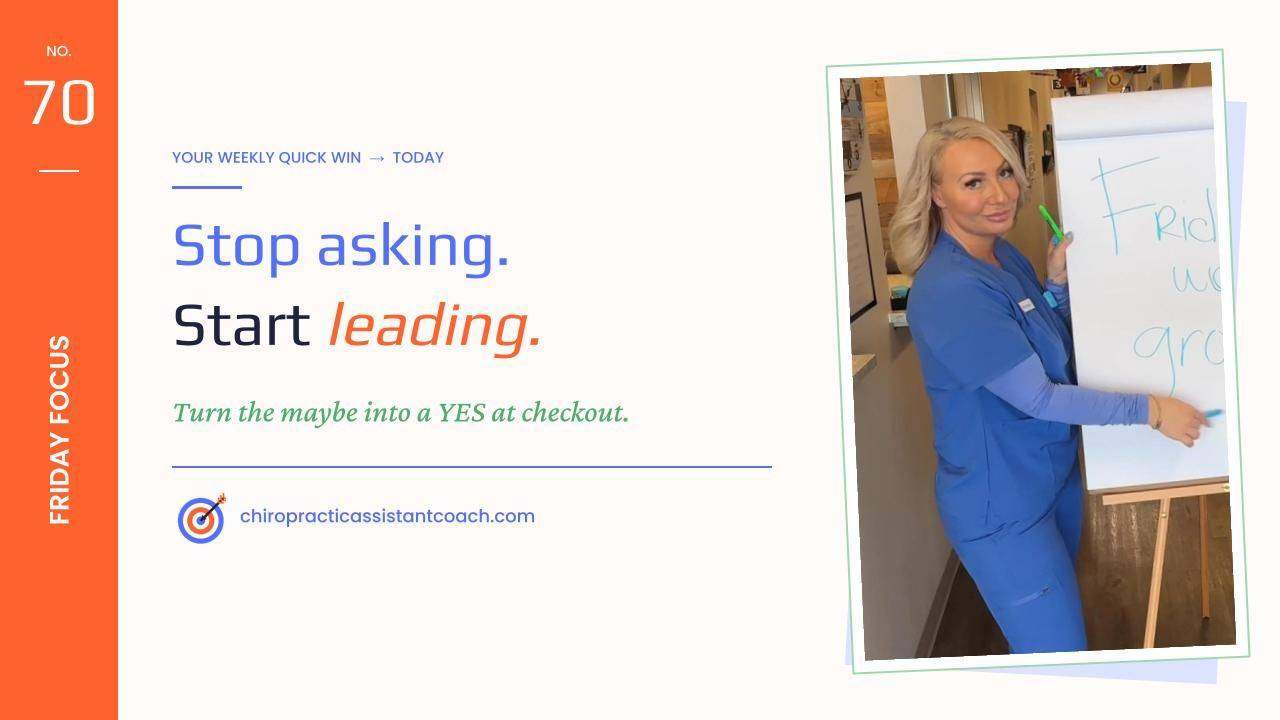
Friday Focus #70 · One quick win your chiropractic team can run today
"Is it okay if I run this card?" sounds polite. Your patient hears a question they now have to answer.
Confident teams don't ask permission to lead a patient forward. They just lead.
The fastest way to make your chiropractic front desk payment conversations more confident is to stop asking permission. Listen for the permission words your team uses ("is it okay if," "would you like to," "how do you want to") and swap ONE of them today. Instead of "Is it okay if I run this card?" try "I have your card ending in 1234 on file. I'll go ahead and run that today." Instead of "if you prepay," say "WHEN you prepay." Say the new line out loud once before your next patient walks in. That's it. One swap.
If you're a D.C. reading this, stay with me... there's a section below just for you. And if you're a C.A. reading this, this is the one I want you to practice in the car on the way to work. 🎯
Your patient hears the hesitation before they hear the ask
Picture it. Your patient just finished their visit. They feel GOOD. They're walking up to the front desk, already halfway out the door in their head.
And your C.A. says, so sweetly, "Okay... how would you like to pay today?"
Nothing wrong with the words. They're kind. And at the very same time, they hand the patient a decision they weren't even thinking about. Now they have to stop, think, choose.
That's the moment a yes turns into a maybe.
Wharton professor Jonah Berger has written about this exact thing. Hedges and tentative language undermine your impact, because while you're making a recommendation, you're also signaling you're not sure it's worth taking. Definite language (words like "definitely") makes people seem more confident and makes listeners more likely to be persuaded (Wharton at Work, April 2023).
Your patients feel that. Every single visit.
So pause here for a second. What did your front desk say at checkout the last time a patient paid? Word for word, if you can remember it.
Today's focus: swap ONE permission word (do this TODAY)
- Think back to your last payment or scheduling conversation. What did you actually say?
- Listen for the permission words: "is it okay if," "would you like to," "how do you want to."
- Swap ONE today. Not "Is it okay if I run this card?" Try: "I have your card ending in 1234 on file. I'll go ahead and run that today." (Add a little nod. Seriously, the nod helps.)
- Swap "if you prepay" for "WHEN you prepay." Confidence, not conditional.
- Say it OUT LOUD once before your next patient walks in. Words feel different in your mouth before they feel different on your face.
One swap. One day. Does that make sense?
You're not deciding for them
Let's not sugarcoat it... every "is that okay?" hands the patient an exit they weren't even looking for.
Let me name what this is NOT. It's not pushing. It's not pressure. It's not taking a choice away from anyone.
Your patient already chose. They chose when they said yes to their care plan. They chose when they put a card on file. You're not deciding for them. You're just done asking permission to lead them forward.
A patient who hears "I'll go ahead and run that today" hears a team that knows what it's doing. A patient who hears "is that okay?" hears a team that isn't sure. Which one would YOU want handling your care?
One word really does matter (a quick story)
Okay, let me tell you about Kelly... because this focus is really about how much weight one word carries.
Kelly is a C.A. I coach. Seasoned. One of the very best. Kelly was on the phone with a prospective patient who shared that he'd felt TRAPPED by other clinics before. Kelly ran a great call. Warm, connected, all of it.
Then, at the very end: "Let's get you LOCKED IN for your appointment."
Locked in. To the man who had just said he felt trapped.
He never showed up.
One word. "Let's get your appointment SECURED" would have landed completely differently. And this happened to one of the BEST C.A.s I know, which is exactly why this matters. Great people say words on autopilot. All of us do.
That's the same reason today's swap works. If one word can push a patient away, one word can also lead them forward. "When" instead of "if." "I'll go ahead" instead of "is it okay." Small words. Big weight.
And the proof that it's available to YOUR office too? Wendy, a C.A. I've coached, put it like this: "Miranda has empowered me to look differently at money. To know that there is always a way to help a patient get the care they need regardless of their financial situation. With her coaching, our patient prepays and retention have about doubled."
About doubled. That started with how Wendy talked about money at the desk.
For my D.C.s reading this
With love, Doc... a lot of the money that slips out of an office doesn't slip out at the report of findings. It slips out at the front desk, one "would you like to?" at a time.
If you're the D.C. whose prepays have stalled, or whose patients keep saying "I'll think about it" at checkout, listen to your front desk for one afternoon. Just listen. Count the permission words. That's not your C.A. failing. That's a C.A. who was never given different words.
And if you're the D.C. who's already crushing it (strong collections, a C.A. who handles money like a pro)... this still matters for you. The best teams don't lose patients in big moments. They lose them in tiny hesitations nobody meant to create.
So here's the task you hand your C.A. today:
"For the rest of today, catch every 'is it okay if' and 'if you prepay' you say. Swap ONE for 'I'll go ahead and' or 'when you prepay.' Tell me before you clock out how the patient responded."
Then at Monday's huddle, ask out loud: "Who swapped a permission word this week, and what happened?"
And one gentle frame, because I care about your practice... giving your team new words is delegating. Expecting them to figure out money conversations on their own is abdicating. Trust them with the words. Keep the question for yourself.
For my C.A.s reading this 🤗
This is your permission slip to LEAD, not just work.
And I totally get it. Asking permission feels polite. It feels respectful. Maybe somebody taught you that asking was the nice thing to do.
But leading IS the nice thing. When you're certain, your patient gets to relax. They don't have to make one more decision at the end of their visit. You've got it.
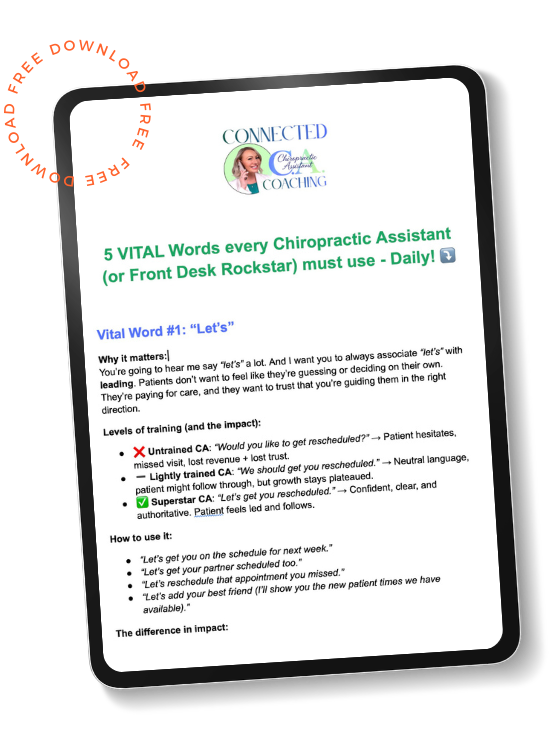
If you want more words like these, I made a free guide called the 5 Vital Words (Let's, Vital, Necessary, Definitely, Secure)... my signature leadership words for patient conversations. DM me the word WORDS on Instagram at @chiropracticassistant and I'll send it to you.
Now practice your swap out loud. In the car, in the break room, wherever. Which permission word are YOU catching first?
Permission seeking teams vs. connected teams
❌ Permission seeking teams ask "is that okay?" and wait for a maybe.
✅ Connected chiropractic teams lead with certainty... and turn a maybe into a YES.
So which one is your front desk? Are you the team asking "is that okay?"... or the one saying "let's get you secured"?
Frequently asked questions
What should a chiropractic front desk say when collecting payment?
Lead instead of asking. "I have your card ending in 1234 on file. I'll go ahead and run that today" is calm and certain. "Is it okay if I run this card?" hands the patient a decision they weren't thinking about. Same respect, less hesitation.
What are permission words, and why do they matter?
Permission words are phrases like "is it okay if," "would you like to," and "how do you want to." They sound polite, but they signal uncertainty. Research on persuasive language (Jonah Berger, Wharton) shows hedging makes a speaker seem less sure of their own recommendation.
Isn't leading a payment conversation pushy?
No. Pushy is pressure. Leading is clarity. The patient already said yes to their care plan or put a card on file. Leading the next step with confidence respects that decision instead of making them decide again.
How do you talk to chiropractic patients about prepaying?
Use "when," not "if." "When you prepay, here's what that looks like for you" assumes the plan your patient already committed to. Pair it with real options so there's always a way for them to get the care they need.
Your one move before you close the tab
You don't need a new payment script. You need one word swap, said out loud, before your next patient.
Swap ONE permission word today. That's today's assignment.
Your patients don't need permission to say yes. They need someone certain enough to lead them there.
🎯 Ready for a front desk that leads every money conversation?
1. Bring me in to coach your team directly. If you want payment and prepay conversations that feel calm and confident every single day, let's talk about what that looks like for your office. Book a no-charge consult and you'll walk away with one clear next step whether or not we work together → calendly.com/miranda-califecoaching/30min
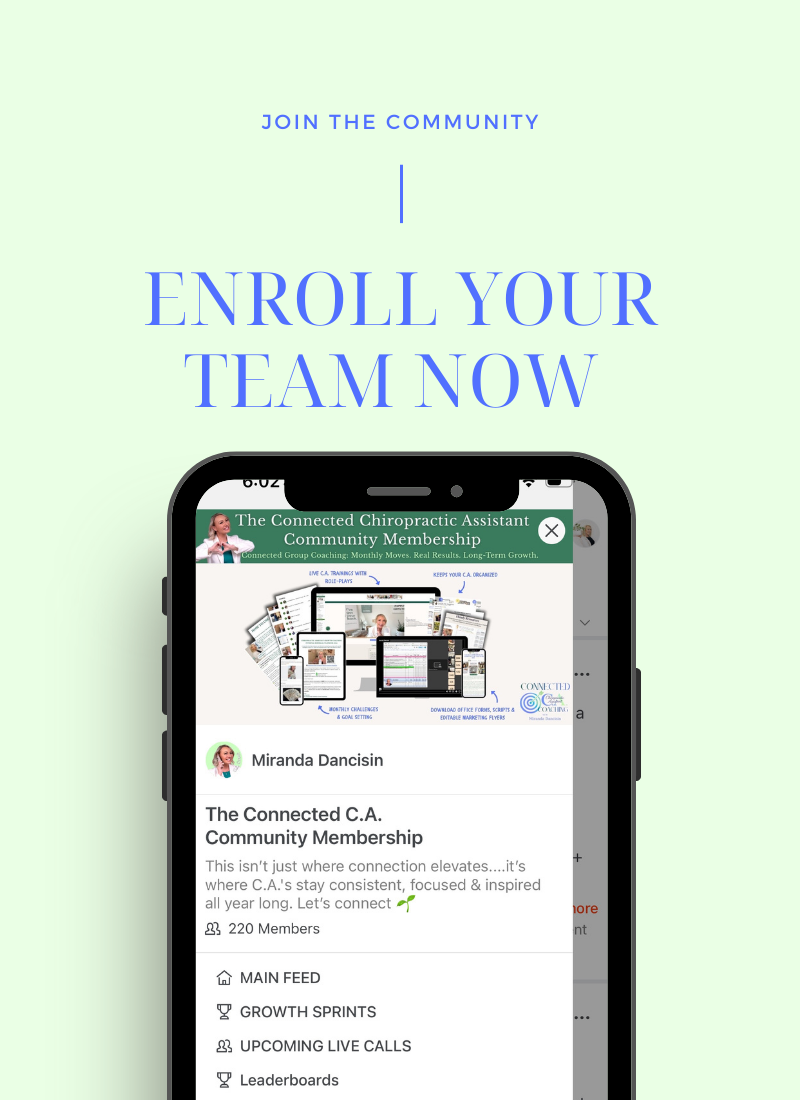
2. Get your team practicing it live. Inside the Connected Community, the monthly Mastery Call is live role play with micro adjustments and the exact phrasing for high stakes moments (money conversations included) → chiropracticassistantcoach.com/chiropractic-assistant-coaching-membership
3. Certify your team in the C3 method. Connect → Commit → Consistently Collect is my 90 day certification that turns hesitant money conversations into confident, heart led ones → chiropracticassistantcoach.com/chiropractic-assistant-training
4. Forward this to your team. Copy this blog's URL and send it to whoever runs payments or scheduling, with one honest question: "Which permission word do we say the most?" Let their answer start Monday's huddle.
If you liked this Focus, you might also like Money Isn't Leaving You. It's Looking for You.... the mindset that makes these money conversations feel natural.
New Friday Focus every Friday. One quick win your chiropractic team can run today (TGIF... Today's Goal Is Focused). Let's grow. 🌱
- Miranda | Founder, The Connected Chiropractic Assistant
 Get the Weekly Newsletter