Every Patient Is Asking You ONE Question | Mindset Monday #77
Oct 05, 2026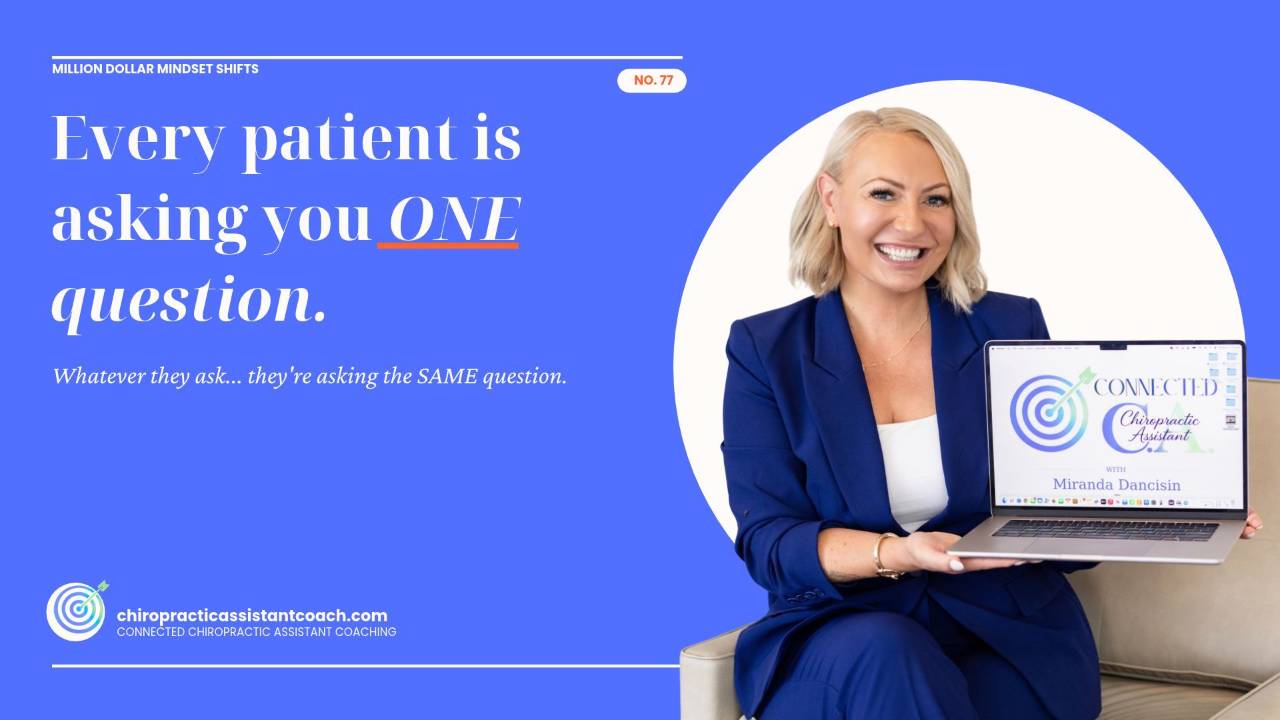
Mindset Shifts from a Million Dollar Chiropractic Assistant #77
Every patient is asking you ONE question.
A new patient calls your chiropractic office and asks, "Do you take my insurance?"
Or, "How much is it?"
Or, "What makes your technique different?"
Three different questions, right? They're not.
Underneath every one of them is the same question... can you help me?
Your chiropractic assistant answers the question they ASKED with words. And they answer the question the patient is LISTENING for with tone. Their voice. Their energy. How certain they sound when they say it. That second answer is the one the patient remembers when they hang up.
Stay with me, Doc. This one changes how you hear every phone call in your office.
Think about the last time YOU called somewhere new
A contractor. A vet. A new doctor for your kid.
Maybe you asked about price. Maybe you asked if they take your insurance, or how soon they could get you in.
But was that REALLY what you wanted to know?
Or were you listening for something else... that moment the person on the other end sounded like they had you. Like you'd called the right place.
That's your new patient on the other end of your line. They just don't have a word for it.
You can give the right answer and still miss the question
Picture this. The phone rings at 4:45 on a Thursday. The front desk is slammed... one patient checking out, another walking in, and the doctor needs something in room two.
"Do you take Blue Cross?"
"Yep, we're in network. Want to book?"
Correct answer. Totally true. Delivered in about three seconds flat, with half of the C.A.'s attention still on the screen.
The patient got the information. They didn't get the certainty. So they say, "Let me check my calendar and call you back."
And you know how that goes.
Nobody did anything WRONG there. That's exactly what makes it so sneaky.
Pause here for a second... think about the last new patient call in your office. What did they ask? And what were they REALLY asking?
They hear it in your tone (yes, even over the phone)
Your words answer the question. Your tone answers the PERSON.
Your pace. Your voice. Whether you sound sure... or like you're apologizing for the number before you even say it. Even your body language, because yes, they can hear you smile.
That sounds a little woo. (It is a little woo. It also has receipts.) Researchers at the University of Portsmouth found that listeners can tell different kinds of smiles apart from audio alone. And a study led by Harvard researcher Nalini Ambady, published in the journal Surgery, linked surgeons' malpractice history to their tone of voice... judged from brief audio clips.
Their TONE. From a few moments of listening.
Your patients are listening for the same thing on your phone line. Before they ever walk through your door.
The day I collected $20K over the phone
Okay, let me tell you a quick story...
It was the height of COVID. I was driving to work when my aunt called. My grandma, in her 90s in North Carolina, had tested positive. I sat in my car outside the office and thought, "It's over."
There was nothing I could do for her from California. So I made a choice. I was going to walk in there and love on the people I COULD help.
I looked at the schedule. Almost no payments on the books. So I just... started calling patients. Something I'd never really done before. I asked if they'd like me to run their payment and get them taken care of early.
That day, I collected $20,000. Over the phone. (And my grandma? She survived.)
What I couldn't stop thinking about afterward... those patients didn't know what I got that morning. They just knew how I made them feel when I picked up the phone.
Do you see what I'm doing there? My words were simple. My energy was the answer. What they heard underneath was, "We've got you."
And that lands right back at your front desk. Your patient can't see your day. They can only HEAR it.
The shift: answer what they asked... AND what they're asking
This is a mindset shift. It releases the old idea that a new patient call is an information desk. It's not. It's the very first moment of care.
Before: they ask about insurance, so you answer about insurance. Done.
After: you answer about insurance, clearly and kindly... and HOW you say it tells them they called the right place.
You still answer the question. Price, insurance, technique... give them the real answer. Clear. Honest. No dodging. (If the money question is the one that makes your stomach drop, I wrote about talking to patients about money at the front desk right here.)
You just answer it like someone who already knows we can help. Because you do.
What that sounds like in real life:
- You pick up the phone already smiling.
- You say the price without a pause, a wince, or a "sooo..." in front of it.
- You use their name, then you get curious: "And what's going on that has you calling us today?"
- You let your certainty land: "You called the right place. Let's get you in."
If you're a D.C. reading this...
Your front desk is the first adjustment a patient ever feels. Before you palpate a single vertebra, your C.A. has already answered "can you help me?"... with a yes, a maybe, or a click.
And if you're the rock-star D.C. with a tight phone script already... I LOVE that for you. Truth over comfort, though. A script answers the question the patient asked. It can't fake the tone that answers the one they're listening for. That part is identity, not wording.
So bring one question to your huddle this week: "On our last new patient call, what were they REALLY asking?" Let your C.A. answer first. Then listen to the next call together. (Same muscle as the real reason patients say "I need to talk to my spouse"... the words on top are rarely the whole story.)
So which office are you building... the one that answers questions, or the one that answers THE question?
For my C.A.s reading this...
You already know the answers. Insurance, pricing, how the doctor adjusts... you could say it in your sleep.
So this one isn't about learning something new. It's about remembering who's on the other end of the line. Someone's mom. Someone's grandpa. Somebody who finally picked up the phone after weeks of "I'll call tomorrow."
Before you pick up: breathe. Sit up. Smile. (Yes, really. They can hear it.)
Karen was a new C.A. when we started coaching together. Karen shared that our coaching built real confidence on new patient calls... insurance questions included. In Karen's own words, the heart of it was "letting them know that they are in great hands!"
That's a C.A. hearing the question underneath. And it's available to you too.
Consider this your permission slip to sound like you KNOW we can help. Because we can.
The shift to walk out with
This week, on your next new patient call, answer what they asked... and let how you sound say, "I can help you."
Just one call. Notice what changes.
Whatever they ask... they're asking, can you help me? 🎯
Hearing the question underneath the question (and answering it with certainty) is the heart of my C3 Certification Program for chiropractic assistants. Connect → Commit → Consistently Collect. Ninety days of coaching that grows a C.A. who answers phones into a C.A. who leads patients to YES.
C3 runs in rounds, not on demand. So the real question isn't "someday." It's which round your C.A. is in... because every new patient call between now and then gets answered with the tone your front desk has TODAY.
👉🏼 See what's inside C3 and grab your C.A.'s seat in the next round
Not sure yet if C3 fits your office? Book a no-charge consult with me and we'll look at your new patient calls together. You'll walk away with real coaching either way.
Then copy this blog's link and text it to your C.A. with one line: "On our next new patient call... what are they REALLY asking?"
With love,
Miranda 🌱
Frequently asked questions about new patient phone calls
What is a new patient really asking on a chiropractic phone call?
Whatever the words are (insurance, price, technique), the question underneath is almost always "can you help me?" A new patient is listening for whether they called the right place. Your chiropractic assistant answers the spoken question with clear information and the unspoken one with a calm, certain, caring tone.
How should a C.A. answer "Do you take my insurance?"
Answer it clearly and honestly first. Then stay on the line as a person, not a database. Use their name, get curious about what's going on that has them calling, and let your tone say you can help. The insurance answer gives them information. Your certainty gives them a reason to book.
How do I answer "How much is it?" without sounding salesy?
Say the number plainly, with no pause, wince, or apology in front of it. Hesitation tells the patient the price is a problem. Then connect the price back to what they told you they want help with. A steady, warm voice answers the question they asked and the one they didn't say out loud.
Can patients really hear tone and a smile over the phone?
Yes. Research from the University of Portsmouth found listeners can tell different kinds of smiles apart from audio alone, and a study in the journal Surgery linked surgeons' malpractice history to their tone of voice from brief audio clips. Your patient can't see your front desk. They can hear it.

 Get the Weekly Newsletter